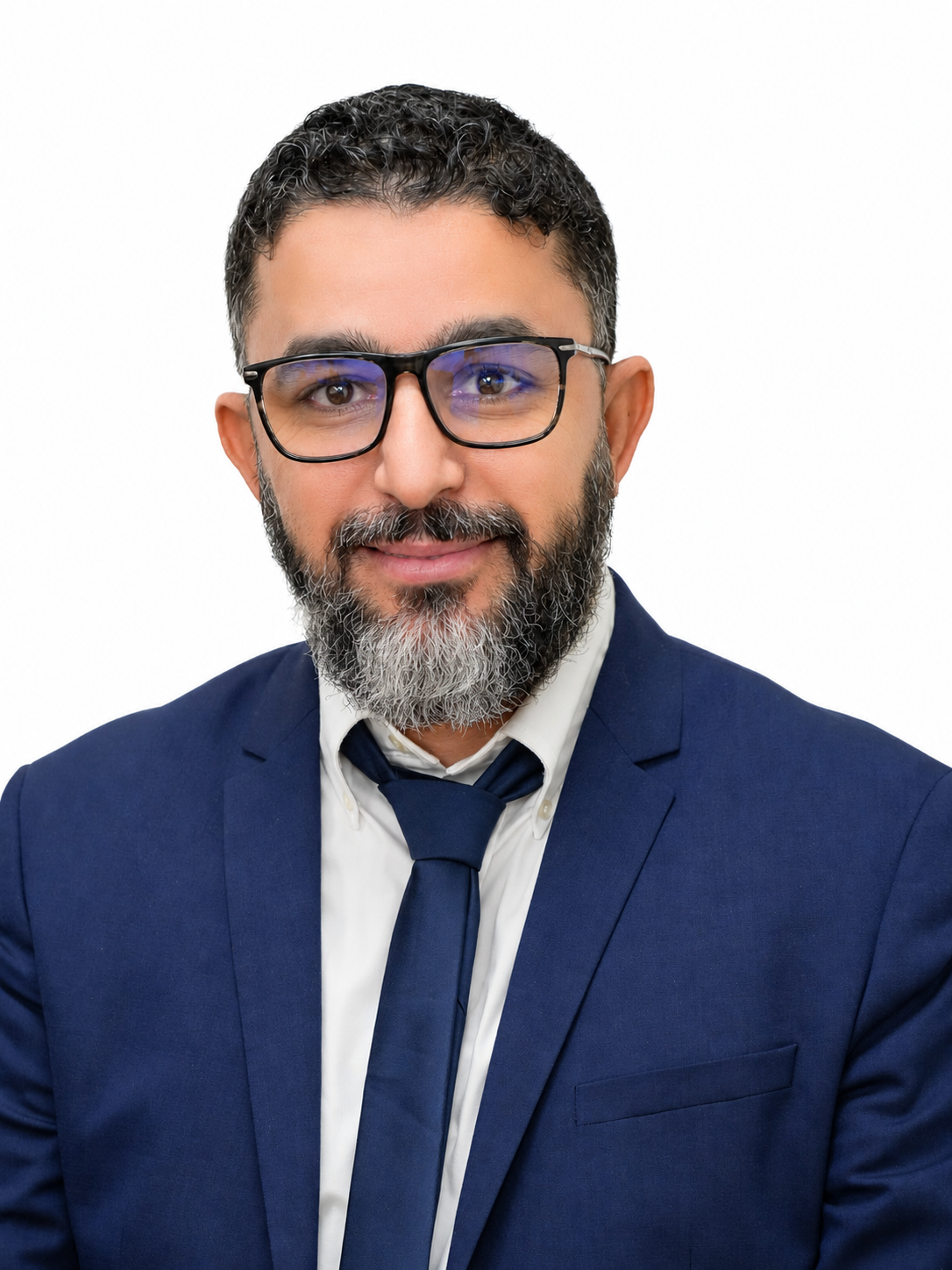
Dr. Mourad Mars joins Prince Mohammad Bin Fahd University as an Assistant Professor in the Department of Artificial Intelligence. He holds a Ph.D. (2012) and an M.Sc. (2006) in Artificial Intelligence and Natural Language Processing (NLP) from Grenoble Alpes University, France. Before joining PMU, Dr. Mars served as an Assistant Professor at Umm Al-Qura University (UQU) in Saudi Arabia. Earlier in his academic career, he held teaching and research appointments in France and Tunisia.
With more than 19 years of experience in teaching, research, and academic leadership, Dr. Mars has taught undergraduate and graduate courses in artificial intelligence, machine learning, deep learning, NLP, data science, and software engineering. During his eight-year tenure as head of department at UQU, he led academic teams across multiple campuses and spearheaded curriculum development, accreditation, quality assurance, and institutional planning. His leadership consistently promoted academic excellence, innovation, and continuous improvement. Dr. Mars believes in combining strong theoretical foundations with hands-on, real-world learning to cultivate critical thinking, creativity, and problem-solving skills in an engaging, student-centered environment.
Dr. Mars is a certified Project Management Professional (PMP®) with a proven track record of securing and leading competitive government-funded AI research projects exceeding 3.5M SAR. His research focuses on Generative AI, NLP, speech technologies, and AI applications in education and healthcare. He actively collaborates with international universities and industry partners to develop innovative AI solutions. He has authored numerous publications in leading Scopus-indexed and ISI journals while serving as a reviewer and program committee member for international conferences and journals.
Dr. Mars is committed to advancing AI research, fostering innovation, building strategic partnerships, and mentoring the next generation of AI professionals. He looks forward to contributing to PMU's mission of academic excellence and supporting Saudi Arabia's Vision 2030 through impactful research, education, and collaboration with industry.
2012 - Ph.D, Artificial Intelligence and Natural Language Processing, Grenoble Alpes University, France
2006 - Master Degree, Computer Science and Natural Language Processing,Grenoble Alpes University, France
2005 - Bachelor Degree, Computer Science, Faculty of Sciences of Monastir, Tunisia
Selected papers:
M. Mars, H. Barmandah and A. Alassaf, "Haakkim: An Arena-Style Platform for Human Preference Evaluation of LLMs in Arabic and Its Dialects," in IEEE Access, vol. 14, pp. 112112-112137, 2026, doi: 10.1109/ACCESS.2026.3710665.
Areej A. Bawazir, Asmaa K. Alshumrani, Reem A. Qaid, Walaa S. Alfahmi, Mourad Mars, "AraEduAgent: Arabic EduAgent Dataset for Peer-Attention Modeling in eLearning", IEEE Access Journal. https://doi.org/10.1109/ACCESS.2026.3699591
Boulahia, A k. Mars, M., "TunDC: A Public Benchmark Dataset for Sentiment Analysis and Language Modeling in the Tunisian Dialect", IAES International Journal of Artificial Intelligence, vol. 15, no. 2, 2026, pp. 1891–1908.
http://doi.org/10.11591/ijai.v15.i2.pp1891-1908.
Wyssem Fathallah, M’hamed Abid, Mourad Mars, Hedi Sakli, "Ensemble-Based Multimodal Deep Learning for Precise Skin Cancer Diagnosis: Integrating Clinical Imagery
with Patient Metadata", Journal of MDPI Technologies, vol. 14, no. 5, p. 277, 2026, https://doi.org/10.3390/technologies14050277
Dalel Ben Ismail, Wyssem Fathallah, Mourad Mars, Hedi Sakli, "NeuroStrainSense: A Transformer-Generative AI Framework for Stress Detection Using Heterogeneous
Multimodal Datasets", Journal of MDPI Technologies, vol. 14, no. 1, p. 35, 2026. https://doi.org/10.3390/technologies14010035.
Lughbi H, Mars M, Almotairi K. A Novel NLP-Driven Dashboard for Interactive CyberAttacks Tweet Classification and Visualization. Information. 2024; 15(3):137. https://doi.org/10.3390/info15030137
Lughbi H, Mars M, Almotairi K. CybAttT: A Dataset of Cyberattack News Tweets for Enhanced Threat Intelligence. Data. 2024; 9(3):39. https://doi.org/10.3390/data9030039
Mars M. From Word Embeddings to Pre-Trained Language Models: A State-of-the-Art Walkthrough. Applied Sciences. 2022; 12(17):8805. https://doi.org/10.3390/app12178805
Btool Hamoui, Mourad Mars, and Khaled Almotairi. 2020. FloDusTA: Saudi Tweets Dataset for Flood, Dust Storm, and Traffic Accident Events. In Proceedings of the Twelfth Language Resources and Evaluation Conference, pages 1391–1396, Marseille, France. European Language Resources Association.
Artificial Intelligence Department, Prince Mohammad Bin Fahd University, Khobar, Saudi Arabia
Since 2026 - Assistant Professor, Artificial Intelligence Department, Prince Mohammad Bin Fahd University, Khobar, Saudi Arabia
2025 - AI consultant, Sandbox AI initiative - National eLearning Center - Saudi Arabia
2025 - eLearning Content Creator and evaluator, FutureX initiative - National eLearning Center - Saudi Arabia
2022-2026 - Assistant Professor, Computer Science and Artificial Intelligence Department, College of Computing, Umm Al-Qura University, Saudi Arabia
2018-2022 - Technical reviewer, Packt Publishing, Birmingham, United Kingdom
2014-2022 - Assistant Professor and Computer Science Department Coordinator, Common First Year (CFY) Deanship, Umm Al-Qura University, Saudi Arabia
2012-2014 - Assistant Professor, High School of Computer Science and Mathematics of Monastir (ISIMM), Tunisia
2009-2011 - Lecturer, Grenoble Alpes University, Grenoble, France
2007-2009 - Lecturer and Regional Representative for the Computer Systems and Networks Program (BTS), Faugier Hays School, Grenoble, France
Graduate Teaching: Generative Artificial Intelligence; Deep Learning; Advanced Natural Language Processing (project-based student projects resulted in research papers publications); Data Science; Machine Learning; Large Language Models; Retrieval-Augmented Generation (RAG) systems and applications.
Undergraduate Teaching: Artificial Intelligence; Introduction to Machine Learning, Data Mining, Data Structures and Algorithms; Database Systems; Software Engineering; Algorithm Design; Project Management; Computer Programming; Discrete Structures, etc.
Teaching Highlights: Designed and delivered AI-driven, research-oriented courses integrating state-of-the-art topics such as LLMs, RAG, and multilingual NLP; extensively utilized Learning Management Systems (LMS) (e.g., Blackboard) to develop structured, interactive course content, including video-based lectures, assessments, and automated feedback workflows; developed high-quality digital learning materials and AI-enhanced instructional resources to support blended and self-paced learning; implemented project-based learning frameworks enabling students to design and deploy end-to-end AI systems; supervised and mentored undergraduate and master’s projects aligned with real-world applications and research outcomes; contributed to curriculum development and continuous improvement processes in alignment with accreditation (ABET, NCAAA).
My research agenda is organized around three interconnected research pillars:
1. Arabic Generative AI and Language Technologies
2. Educational AI and Intelligent Learning Systems
3. Multimodal and Human-Centered AI
Since 2025 - Artificial Intelligence Association, Saudi Arabia (www.aia.org.sa)
Since 2025 - Nauatech, Saudi Arabia (www.naua.tech)