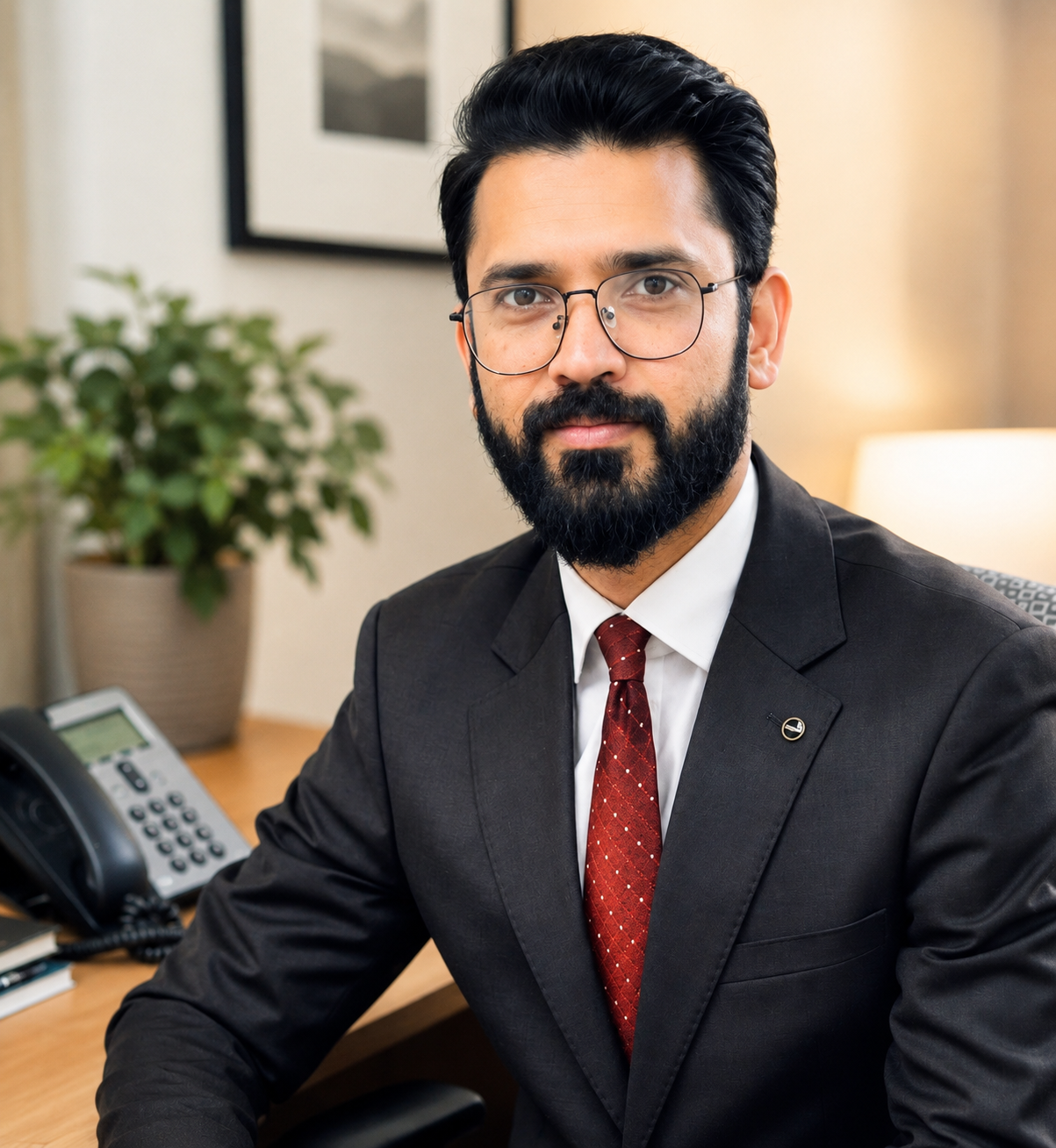
MUHAMMAD ASGHAR KHAN, (Senior Member, IEEE) is an Associate Research Professor in the Department of Electrical Engineering at Prince Mohammad Bin Fahd University (PMU), Saudi Arabia. Before joining PMU, Dr. Khan served as an Associate Professor and Head of the Electrical Engineering Department at Hamdard University, Islamabad. During his tenure, he spearheaded the successful accreditation of the Electrical Engineering Program under the Washington Accord for the 2019–2022 intake batches. He also served as a researcher at the Smart Systems Engineering Lab (SSEL) at Prince Sultan University, KSA, from June 2022 to June 2023.
Dr. Khan is a distinguished researcher, having authored and co-authored over 130 technical and review articles published in leading journals, including IEEE Transactions on Vehicular Technology, IEEE Transactions on Industrial Informatics, IEEE Transactions on Intelligent Transportation Systems, IEEE Transactions on Network and Service Management, IEEE Internet of Things and other reputed journals. He actively contributes to the academic community as a reviewer and editor for numerous international journals and conferences. His contributions have earned him a place among Stanford University's Top 2% of Scientists in 2023,2024 and 2025, reflecting his profound impact on the field. Additionally, he received the Best Researcher Award from Hamdard University and its campuses for three consecutive years (2021–2023).
Dr. Khan's research interests are focused on the development and integration of advanced technologies in Drones/UAVs. His work encompasses network architectures, security frameworks, platform innovations, and cutting-edge applications for UAV systems. His commitment to academic excellence and impactful research demonstrates his dedication to advancing technology and shaping the future of modern engineering solutions.
PhD in Electronic Engineering
MS in Electrical Engineering
BE in Electronic Engineering
-
Muhammad Asghar Khan and Muhammad Attique Khan, “Securing IoT in the post-quantum era: implementation, challenges and future directions,” IEEE Communications Standards Magazine, Early Access, Nov. 23, 2025.
-
Muhammad Asghar Khan, Insaf Ullah, Haralambos Mouratidis, Abdulmajeed Alqhatani, and Pascal Lorenz, “A hyperelliptic curve-based authenticated key agreement scheme for unmanned aerial vehicles in cross-domain environments,” Chinese Journal of Aeronautics, vol. 38, no. 10, Art. no. 103495, Oct. 2025.
-
Muhammad Asghar Khan, Gordana Barb, and Fazal Noor, “Exploring computationally efficient signcryption mechanisms for unmanned aerial vehicles (UAVs): a comparative review,” Iran Journal of Computer Science, Early Access, Sept. 19, 2025.
-
Muhammad Asghar Khan, “Securing UAV networks: exploring computationally efficient authentication protocols,” in Proc. 2025 IEEE 34th Wireless and Optical Communications Conference (WOCC), May 20, 2025.
-
Muhammad Asghar Khan, Insaf Ullah, Neeraj Kumar, Adnan Akhunzada, Mohammad Hossein Anisi, and Abdulmajeed Alqhatani, “An improvised certificate-based proxy signature using hyperelliptic curve cryptography for secure UAV communications,” IEEE Transactions on Intelligent Transportation Systems, Early Access, 2025.
-
Muhammad Asghar Khan, Neeraj Kumar, Saeed Hamood Alsamhi, Gordana Barb, Justyna Zywiołek, and Insaf Ullah, “Security and privacy issues and solutions for UAVs in B5G networks: a review,” IEEE Transactions on Network and Service Management, vol. 22, no. 1, 2025.
-
Salabat Khan, Mansoor Khan, Muhammad Asghar Khan, Fei Luo, Muhammad Usman, Azeem Irshad, Kaishun Wu, Lu Wang, and Muhammad Attique Khan, “PBatch: pseudonym certificate batch authentication with generative AI-based cache for cooperative intelligent transportation systems,” IEEE Transactions on Intelligent Transportation Systems, Early Access, Nov. 18, 2025.
-
Salabat Khan, Mansoor Khan, Muhammad Asghar Khan, Muhammad Attique Khan, Lu Wang, and Kaishun Wu, “A blockchain-enabled AI-driven secure searchable encryption framework for medical IoT systems,” IEEE Journal of Biomedical and Health Informatics, Early Access, Nov. 15, 2025.
-
Wasim Ahmad, Farman Ali, Yasir Ullah, Muhammad Asghar Khan, Mansoor Khan, Salabat Khan, Muhammad Attique Khan, Aitizaz Ali, and Shahad Almansour, “IoUT and collaborative cloud computing-based UAV channel modeling for agriculture communication,” IEEE Transactions on Consumer Electronics, Early Access, Oct. 24, 2025.
-
Salabat Khan, Mansoor Khan, Muhammad Asghar Khan, Lu Wang, and Kaishun Wu, “Advancing medical innovation through blockchain-secured federated learning for smart health,” IEEE Journal of Biomedical and Health Informatics, Early Access, Oct. 23, 2025.
-
Tao Li, Peiyao Niu, Salabat Khan, Muhammad Asghar Khan, Mansoor Khan, Muhammad Attique Khan, Yilei Wang, and Amir Hussain, “APR-FL: defending against hidden backdoor attacks with adaptive parameter replacement,” IEEE Transactions on Consumer Electronics, Early Access, Oct. 22, 2025.
-
Saddam Hussain, Ali Tufail, Haji Awg Abdul Ghani Naim, Muhammad Asghar Khan, and Gordana Barb, “A lightweight proxy signature scheme for resource-constrained NDN-based Internet of Vehicles,” IEEE Open Journal of Vehicular Technology, Early Access, Oct. 9, 2025.
-
Muhammad Khubaib, Tanzila Kehkashan, Maha Abdelhaq, Muhammad Asghar Khan, Muhammad Zaman, Imran Ashraf, Abdul Rehman, and Adnan Akhunzada, “Data-efficient wheat disease detection using shifted window transformer: enhancing accuracy, sustainability, and global food security,” IEEE Transactions on Consumer Electronics, Early Access, Aug. 23, 2025.
-
Naeem Khan, Shibli Nisar, Muhammad Asghar Khan, Muhammad Attique Khan, David Camacho, Yasar Abbas Ur Rehman, and Amir Hussain, “Federated learning: concepts, challenges and implementation,” Expert Systems, Early Access, Aug. 2025.
-
Naeem Khan, Shibli Nisar, Muhammad Asghar Khan, Yasar Abbas Ur Rehman, Fazal Noor, and Gordana Barb, “Optimizing federated learning with aggregation strategies: a comprehensive survey,” IEEE Open Journal of the Computer Society, Early Access, Jul. 17, 2025.
-
Saddam Hussain, Ali Tufail, Haji Awg Abdul Ghani Naim, Muhammad Asghar Khan, and Gordana Barb, “Evaluation of computationally efficient identity-based proxy signatures,” IEEE Open Journal of the Computer Society, Early Access, May 26, 2025.
-
Yasir I. Mohammed, Rosilah Hassan, Mohammad Kamrul Hasan, Shayla Islam, and Muhammad Asghar Khan, “Revolutionizing FANETs with reinforcement learning: optimized data forwarding and real-time adaptability,” IEEE Open Journal of the Communications Society, Early Access, May 1, 2025.
-
Liaqat Ali, Man-Fai Leung, Muhammad Asghar Khan, Redhwan Nour, Yakubu Imrana, and Athanasios V. Vasilakos, “ChiGa-Net: a genetically optimized neural network with refined deeply extracted features using χ² statistical score for trustworthy Parkinson’s disease detection,” Neurocomputing, vol. 624, Art. no. 129450, Apr. 2025.
-
Sanaz Amanlou, Mohammad Kamrul Hasan, Umi Asma Mokhtar, Khalid Mahmood Malik, Shayla Islam, Sheroz Khan, Muhammad Attique Khan, and Muhammad Asghar Khan, “Cybersecurity challenges in smart grid systems: current and emerging attacks, opportunities, and recommendations,” IEEE Open Journal of the Communications Society, Early Access, Feb. 25, 2025.
-
Muhammad Rashid Naeem, Muhammad Asghar Khan, Mansoor Khan, Omar Alruwaili, Ibrahim Alrashdi, and Saad Alanazi, “Enhancing software quality assurance in ubiquitous learning environments through mutation testing and diverse test oracles,” Computers in Human Behavior, Early Access, Art. no. 108493, Feb. 2025.
-
Shumaila Javaid, Muhammad Asghar Khan, Hamza Fahim, Bin He, and Nasir Saeed, “Explainable AI and monocular vision for enhanced UAV navigation in smart cities: prospects and challenges,” Frontiers in Sustainable Cities, vol. 7, Art. no. 1561404, Jan. 14, 2025.
-
Rana Muhammad Amir Latif, Farhan Ullah, Nasir Jamal, Yue Zhao, Sohail Jabbar, and Muhammad Asghar Khan, “Explainable AI for big data analytics in urban mobility forecasting,” in Proc. 2025 IEEE International Conference on Pattern Recognition, Machine Vision and Artificial Intelligence (PRMVAI), Jan. 13, 2025, pp. 1–5.
-
Muhammad Asghar Khan, Neeraj Kumar, Syed Agha Hassnain Mohsan, Wali Ullah Khan, Mostafa Alsharif, Justyna, and Insaf Ullah, “Swarm of UAVs for Network Management in 6G: A Technical Review,” IEEE Transactions on Network and Service Management, vol. 20, no. 1, pp. 741–761, 2024.
-
Muhammad Asghar Khan et al., “A certificate-based ring signcryption scheme for securing UAV-enabled private edge computing systems,” IEEE Access, 2024.
-
Muhammad Asghar Khan et al., “An efficient authentication and access control protocol for securing UAV networks against anomaly-based intrusion,” IEEE Access, 2024.
-
Muhammad Asghar Khan et al., “A comparison on the battery consumption and data transfer efficiency of 4G/5G systems,” in Proc. IEEE INC–USNC–URSI Radio Science Meeting, 2024.
-
Muhammad Asghar Khan et al., “Future-proofing security for UAVs with post-quantum cryptography: a review,” IEEE Open Journal of the Communications Society, 2024.
-
Muhammad Asghar Khan, Hosam Alhakami, Insaf Ullah, Wajdi Alhakami, Syed Agha Hassnain Mohsan, Usman Tariq, and Nasreen Inaab, “A resource-friendly certificateless proxy signcryption scheme for drones in networks beyond 5G,” Drones, vol. 7, no. 5, 2023.
-
Muhammad Asghar Khan, Insaf Ullah, Ako Muhammad Abdullah, Syed Hussain Agha Mohsin, and Fazal Noor, “An efficient and conditional-privacy preserving heterogeneous signcryption scheme for the Internet of Drones,” Sensors, 23, 2023.
-
Muhammad Asghar Khan, Hosam Alhakami, Wajdi Alhakami, Alexey V. Shvetsov, and Insaf Ullah, “A smart card-based two-factor mutual authentication scheme for efficient deployment of an IoT-based telecare medical information system,” Sensors, 23(12), 2023.
-
Asad Iqbal, Muhammad Zubair, Muhammad Asghar Khan, Insaf Ullah, Ghani Ur-Rehman, Alexey V. Shvetsov, and Fazal Noor, “An efficient and secure certificateless aggregate signature scheme for vehicular ad hoc networks,” Future Internet, 15(8):258, 2023.
-
Jamshed Ali Shaikh, Chengliang Wang, Muhammad Asghar Khan, Syed Agha Hassnain Mohsan, Saif Ullah, Samia Allaoua Chelloug, Mohammed Saleh Ali Muthanna, and Ammar Muthanna, “A UAV-assisted Stackelberg game model for securing IoMT healthcare networks,” Drones, 7(7), 2023.
-
Shehzad Ashraf Chaudhry, Azeem Irshad, Muhammad Asghar Khan, Sajjad Ahmad Khan, Sumeera Nousheen, Ahmad Ali, and Yousaf Bin Zikiria, “A lightweight authentication scheme for 6G-IoT enabled maritime transport system,” IEEE Transactions on Intelligent Transportation Systems, 24(2):2401–2410, 2023.
-
Insaf Ullah, Muhammad Asghar Khan, Neeraj Kumar, Ako Muhammad Abdullah, Abeer Abdullah, and Fazal Noor, “A conditional privacy preserving heterogeneous signcryption scheme for Internet of Vehicles,” IEEE Transactions on Vehicular Technology, 72(3):3989–3998, 2023.
-
Insaf Ullah, Muhammad Asghar Khan, Ako Muhammad Abdullah, Fazal Noor, Nisreen Innab, and Chien-Ming Chen, “Enabling secure communication in wireless body area networks with heterogeneous authentication scheme,” Sensors, 23(3):1121, 2023.
-
Mamoona Jamil, Mubashar Sarfraz, Sajjad A. Ghauri, Muhammad Asghar Khan, Mohamed Marey, and Hala Mostafa, “Optimized classification of intelligent reflecting surface (IRS)-enabled GEO satellite signals,” Sensors, 23:4173, 2023.
-
Arash Rayegani, Mohammadmohsen Saberian, Zahra Delshad, Junwei Liang, Muhammad Sadiq, Ali Matin Nazar, Syed Agha Hassnain Mohsan, and Muhammad Asghar Khan, “Recent advances in self-powered wearable sensors based on piezoelectric and triboelectric nanogenerators,” Biosensors, 13(1):37, 2023.
-
Syed Agha Hassnain Mohsan, Yanlong Li, Muhammad Sadiq, Junwei Liang, and Muhammad Asghar Khan, “Recent advances, future trends, applications and challenges of Internet of Underwater Things (IoUT): a comprehensive review,” Journal of Marine Science and Engineering, 11(1):124, 2023.
-
Ubaid Ur Rahman Qureshi, Shahid Basir, Fazal Subhan, Syed Agha Hassnain Mohsan, Muhammad Asghar Khan, Mohamed Marey, and Hala Mostafa, “A miniaturized arc-shaped near-isotropic self-complementary antenna for spectrum sensing applications,” Sensors, 23(2):927, 2023.
-
Shahid Basir, Ubaid Ur Rahman Qureshi, Fazal Subhan, Muhammad Asghar Khan, Syed Agha Hassnain Mohsan, Yazeed Yasin Ghadi, Khmaies Ouahada, Habib Hamam, and Fazal Noor, “A novel monopole ultra-wide-band multiple-input multiple-output antenna with triple-notched characteristics for enhanced wireless communication and portable systems,” Sensors, 23(15), 2023.
-
Syed Agha Hassnain Mohsan, Nawaf Qasem Hamood Othman, Yanlong Li, Mohammed H. Alsharif, and Muhammad Asghar Khan, “Unmanned aerial vehicles (UAVs): practical aspects, applications, open challenges, security issues, and future trends,” Intelligent Service Robotics, 2023.
-
Syed Agha Hassnain Mohsan, Muhammad Asghar Khan, and Mumtaz Karatas, “Editorial for the Special Issue on Micro Air Vehicles,” Micromachines, vol. 14, no. 4, Art. no. 721, 2023.
-
Syed Agha Hassnain Mohsan, Muhammad Asghar Khan, and Yazeed, “Editorial on the Topic Issue of Advances, Innovations and Applications of UAV Technology for Remote Sensing,” Remote Sensing, 2023.
-
Syed Agha Hassnain Mohsan, Muhammad Asghar Khan, and Hussain Amjad, “Hybrid FSO/RF networks: a review of practical constraints, applications and challenges,” Optical Switching and Networking, 2023.
-
Asrar Ahmed Sabir, Muhammad Asghar Khan, and coauthors, “Consumer acceptance and adoption of AI robo-advisors in FinTech industry,” Mathematics, vol. 11, no. 6, Art. no. 1311, 2023.
-
Tahir Ali Shah, Muhammad Asghar Khan, and coauthors, “An efficient certificateless forward-secure signature scheme for secure deployments of the Internet of Things,” Journal of Sensor and Actuator Networks, vol. 12, no. 1, Art. no. 10, 2023. (Full author list not provided.)
-
Zainab Jamroz, Muhammad Asghar Khan, and coauthors, “An optimal authentication scheme through dual signature for the Internet of Medical Things,” Future Internet, vol. 15, no. 8, Art. no. 258, 2023.
-
Muhammad Asghar Khan, Tanweer Ahmad Cheema, Insaf Ullah, et al., “A dual-mode medium access control mechanism for UAV-enabled ITS,” Mobile Information Systems, 2021.
-
Muhammad Asghar Khan, Fazal Noor, Insaf Ullah, Sajjad Ur Rehman, Shibli Nisar, and Mohaira Ahmad, “An efficient medium access control mechanism using directional antennas for flying ad-hoc networks,” Computer Systems Science and Engineering, 38(1):47–63, 2021.
-
Muhammad Asghar Khan, Insaf Ullah, Sajjad Ur Rehman, Neeraj Kumar, and Danish, “Securing Internet of Drones with identity-based proxy signcryption,” IEEE Access, 9:89133–89142, 2021.
-
Muhammad Asghar Khan, Insaf Ullah, Shibli Nisar, Fazal Noor, Ijaz Mansoor Qureshi, Fahim Ullah Khanzada, and Noor Ul Amin, “An efficient and provably secure certificateless key-encapsulated signcryption scheme for flying ad-hoc network,” IEEE Access, 8:36807–36828, 2020.
-
Insaf Ullah, Muhammad Asghar Khan, Mohammad H. Alsharif, and Nordin, “An anonymous certificateless signcryption scheme for secure and efficient deployment of Internet of Vehicles,” Sustainability, 13:10891, 2021.
-
Insaf Ullah, Muhammad Asghar Khan, Ali Alkhalifa, Nordin, and Mohammad H. Alsharif, “A multi-message multi-receiver signcryption scheme with edge computing for secure and reliable wireless Internet of Medical Things communications,” Sustainability, 13(23):13184, 2021.
-
Muhammad Fawad Khan, Muhammad Azam, Muhammad Asghar Khan, et al., “A review of big data resource management: using smart grid systems as a case study,” Wireless Communications and Mobile Computing, 2021.
-
Alamgir Safi, Muhammad Asghar Khan, et al., “Application of differential geometry to the array manifolds of linear arrays in antenna array processing,” Electronics, 10(23):2964, 2021.
-
Ehab Ur Rahman, Muhammad Asghar Khan, et al., “Computer vision-based wildfire smoke detection using UAVs,” Mathematical Problems in Engineering, 2021.
-
Ali Muammad, Noor Ul Amin, Muhammad Asghar Khan, et al., “An efficient scheme for Industrial Internet of Things using certificateless signature,” Mathematical Problems in Engineering, 2021.
-
Muhammad Asghar Khan, Insaf Ullah, Shibli Nisar, “Multiaccess edge computing empowered flying ad-hoc networks with secure deployment using identity-based generalized signcryption scheme,” Mobile Information Systems, 2020.
-
Muhammad Asghar Khan, Sajjad Ur Rehman, Shibli Nisar, Insaf Ullah, Fazal Noor, and Irfan Uddin, “An online-offline certificateless signature scheme for Internet of Health Things,” Journal of Healthcare Engineering, 2020.
-
Muhammad Asghar Khan, Ijaz Mansoor Qureshi, Insaf Ullah, Suleman Khan, Fahim Ullah Khanzada, and Fazal Noor, “An efficient and provably secure certificateless blind signature scheme for flying ad-hoc network based on multi-access edge computing,” Electronics, 9(1), 2020.
-
Muhammad Asghar Khan, Insaf Ullah, Shibli Nisar, Fazal Noor, Ijaz Mansoor Qureshi, Fahim Ullah Khanzada, and Noor Ul Amin, “An efficient and provably secure certificateless key-encapsulated signcryption scheme for flying ad-hoc network,” IEEE Access, 8:36807–36828, 2020.
-
Insaf Ullah, Noor Ul Amin, Muhammad Asghar Khan, and Hizbullah Khattak, “Lightweight and provable secure cross-domain access control scheme for IoT-based WBAN,” Microprocessors and Microsystems, 81, 2020.
-
Insaf Ullah, Muhammad Asghar Khan, Hizbullah Khattak, “A lightweight and secured certificate-based signcryption with proxy re-encryption (CBSRE) for IoT-enabled smart grid,” IEEE Access, 8:93230–93248, 2020.
-
Syed Sajid Ullah, Insaf Ullah, Hizbullah Khattak, and Muhammad Asghar Khan, “A lightweight identity-based signature scheme for mitigation of content poisoning attack in NDN with IoT,” IEEE Access, 8:98910–98928, 2020.
-
Muhammad Asghar Khan, Ijaz Mansoor Qureshi, and Fahim Ullah, “A hybrid communication scheme for efficient and low-cost deployment of future FANET,” Drones, 3(1):16, Feb. 2019.
-
Muhammad Asghar Khan, Abdullah Khalid, and Fahim Ullah, “Dual-radio dual-band configuration for flexible communication in FANET,” in Proc. ComTech-2019, 2019.
-
Muhammad Asghar Khan, Inam Ullah Khan, Alamgir Safi, and Ijaz Mansoor Qureshi, “Dynamic routing in flying ad-hoc networks using topology-based routing protocols,” Drones, 2(3):27, Aug. 2019.
-
Muhammad Asghar Khan, Inam Ullah Khan, Ijaz Mansoor Qureshi, Adnan Nasim, Usman Javed, and Wasif Khan, “On the performance of flying ad-hoc networks (FANETs) with directional antennas,” in Proc. 2018 Int. Multi-Topic ICT Conf. (IMTIC), 2018.
-
Muhammad Asghar Khan, Inam Ullah Khan, Ijaz Mansoor Qureshi, and others, “Deployment of reliable, simple, and cost-effective MAC protocols for multi-layer FANETs,” in Proc. 2nd Int. Conf. Future Networks and Communications, 2018.
-
Muhammad Asghar Khan, Inam Ullah Khan, Ijaz Mansoor Qureshi, and others, “Ant colony-based optimization technique to mitigate dynamic routing challenges in packet-based networks,” in Proc. 2nd Int. Conf. Future Networks and Communications, 2018.
-
Muhammad Asghar Khan, Inam Ullah Khan, Ijaz Mansoor Qureshi, and Adnan Nasim, “Comparative analysis and route optimization of state-of-the-art routing protocols,” EAI Endorsed Transactions on Mobile Communications and Applications, 2018.
-
Muhammad Asghar Khan, I. M. Qureshi, A. Safi, and I. U. Khan, “Flying ad-hoc networks (FANETs): a review of communication architectures and routing protocols,” in Proc. 2017 1st Int. Conf. Latest Trends in Electrical Engineering and Computing Technologies (INTELLECT), Karachi, Pakistan, Nov. 2017, pp. 692–699.
|
Sept 2024-
Present
Dec 2022-
Sept 2024
Dec 2021-
Dec-2022
Aug 2014-
Dec 2021
June 2013-
Aug 2014
April 2012-
June 2013
|
Associate Research Professor
Department of Electrical Engineering
PMU, KSA
Associate Professor
Department of Electrical Engineering
Hamdard University, Islamabad
Assistant Professor
Department of Electrical Engineering
Hamdard University, Islamabad
Lecturer
Department of Electrical Engineering
Hamdard University, Islamabad
Lab Engineer
Department of Electrical Engineering
Hamdard University, Islamabad
Visiting Faculty
Department of Electrical Engineering
Hamdard University, Islamabad
|
Linear Circuit Analysis
Basic Electronics
Electronics II
Data Communication and Networks
Computer Networks
Cybersecurity
UAVs/Drones,
5G/6G Networks,
Blockchain,
Federated Learning,
Post-Quantum Cryptography
ACM Professional Member
Pakistan Engineering Council
The Institute of Engineers Pakistan